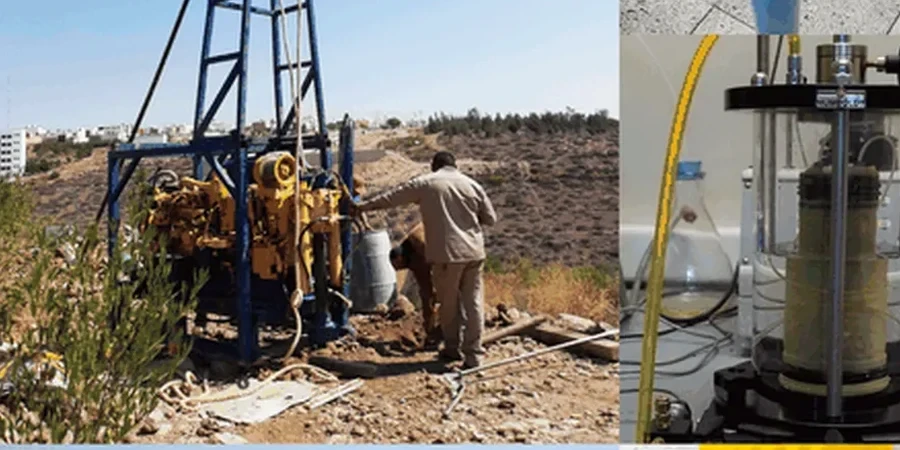
The soil profile between the older neighborhoods near the 210 freeway and the expanding industrial parks south of the 10 freeway in San Bernardino can shift dramatically within a single site. We see gravel lenses in one borehole and twenty feet of loose sandy silt in the next, a legacy of the ancestral Santa Ana River that has braided across this valley for millennia. This variability demands a vibrocompaction design that is not a generic template but a precise engineering response to the specific gradation and depth of the deposit. When we combine our laboratory grain size analysis with in-situ CPT soundings, we can determine whether the material will respond to vibratory densification or if a different ground improvement strategy, such as stone columns, becomes necessary to bridge the deeper, finer zones that vibroflots cannot effectively treat.
Effective vibrocompaction in San Bernardino is about hitting the right frequency-amperage combination that collapses the loose alluvial structure without wasting energy on silt pockets that will never densify.
Site-specific factors
A warehouse project near San Bernardino International Airport ran into trouble when the contractor assumed uniform sand across the pad and skipped the pre-design CPT grid. The vibroflot hit a buried clay lens at 22 feet, the amperage spiked, and the crew kept pulling the probe without adjusting the lift thickness—the result was a dense crust over an untreated layer that settled six inches the first time the slab was loaded with racking. We were brought in to do forensic CPT soundings and redesign the grid with staggered probe depths, targeting the clay pocket with a transition zone of coarser imported fill to bridge the differential stiffness. That project cost twice as much to remediate as it would have to design properly from the start. The lesson is that vibrocompaction design without a detailed stratigraphic model is just guesswork, and in a city with a seismic hazard class as high as San Bernardino, guesswork can translate into a differential settlement failure during a major earthquake, compromising both the structure and the operational continuity of the business inside.
Reference standards
IBC (International Building Code, with California amendments), ASCE 7-22 Minimum Design Loads for Buildings and Other Structures, ASTM D2487 Standard Practice for Classification of Soils, ASTM D5778 Standard Test Method for Electronic Friction Cone and Piezocone Penetration Testing, California Building Code (CBC) Title 24, Part 2
Questions and answers
What is the cost range for a vibrocompaction design in San Bernardino?
The design package, including the CPT grid, analysis, and the final specification document, typically falls between US$1,480 and US$5,280 depending on the site area and the complexity of the stratigraphy. A larger industrial lot with highly variable alluvial lenses requires more soundings and more engineering time than a small, uniform pad, so the cost scales with the number of treatment zones we need to characterize.
How deep can vibrocompaction effectively treat the loose soils we find here?
In the San Bernardino basin, we routinely design treatment depths from 15 feet down to 65 feet. The practical limit is usually the water table position and the capability of the vibrator; most rigs can reach 65 feet without a problem, and the deep alluvial deposits here respond well as long as the fines content stays below the threshold where the pore pressure cannot dissipate between passes.
How do you verify that the compaction actually worked?
We run a pre-treatment CPT at every critical zone, then repeat the same test at the same locations after the vibroflot has completed all passes. The increase in cone tip resistance is converted to a relative density value, and we compare that against the 70 to 80 percent target. We also look at the sleeve friction ratio to confirm the soil behavior type hasn't shifted unexpectedly. The entire verification is documented in a report that you can submit to the city for your permit closeout.
Can vibrocompaction be used if my site has a high water table?
Yes, and in fact a high water table is actually required for effective vibrocompaction; the method relies on saturated soil to transmit the vibratory energy and allow the grains to rearrange into a denser packing. Many San Bernardino sites have groundwater at 30 feet or less, which is ideal. If the soil is dry above the water table, we typically specify a pre-wetting phase or switch to a different technique for that upper zone.
What makes the San Bernardino area different for vibrocompaction compared to other Southern California cities?
The combination of the deep Santa Ana River alluvium, the proximity to both the San Andreas and San Jacinto fault systems, and the presence of interbedded silt and clay lenses within the sand deposits creates a more complex treatment environment than, say, the cleaner dune sands along the coast. Our designs here have to account for lateral stratigraphic changes over very short distances and the higher design spectral accelerations that push the target relative density requirements upward.