← Home · Slopes & Walls

Active/Passive Anchor Design in San Bernardino, CA | Geotechnical Support

Together, we solve the challenges of tomorrow.

LEARN MORE →

San Bernardino sits at 1,053 feet of elevation, but the real challenge for geotechnical work is below grade. The 1994 Northridge and 1992 Landers events proved that anchor systems in this valley must handle not just static loads but also cyclic seismic demand. We design active and passive anchors for shoring, retaining walls, and slope stabilization in the coarse alluvial deposits typical of the Santa Ana River basin. For soft zones or loose sands, we pair the anchor design with CPT testing to map the stratigraphy and with slope stability analysis when the cut is near an existing embankment.

A properly designed anchor in San Bernardino alluvium can hold 150 kips — but only if the grout-to-ground bond is verified with site-specific pullout tests.

How we work

A 30-foot-deep excavation along Hospitality Lane exposed interbedded silts and gravels that required a tieback system with active prestress. We specified 150-kip anchors with a bond length of 25 feet in the cemented conglomerate layer, verified through load tests. For passive anchors, we rely on grout-to-ground bond values from FHWA guidelines, adjusted with site-specific pullout tests. In the Bunker Hill area, we combined passive anchors with a mat foundation to resist uplift in a high-water-table scenario. Every anchor undergoes proof testing to 133% of the design load, per IBC 2021 and PTI DC-35.1 recommendations.
Active/Passive Anchor Design in San Bernardino, CA | Geotechnical Support
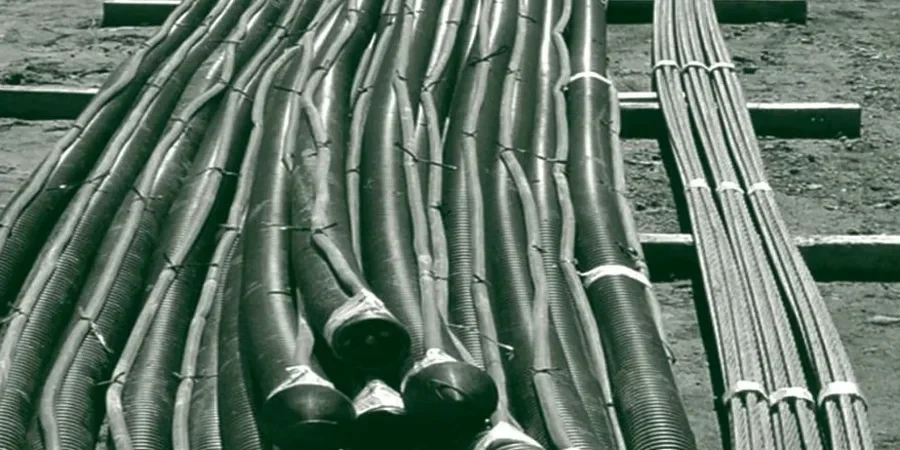
Technical reference image — San Bernardino

Site-specific factors

ASCE 7-22 §12.13 requires that anchored walls resist seismic earth pressures, and in San Bernardino — with an Ss of 2.0g near the San Jacinto fault — that demand is real. Creep failure in the bond zone is the primary risk: if the grout-to-ground interface degrades under cyclic loading, the wall can move outward and compromise adjacent structures. We mitigate this with performance tests that include a 60-minute creep hold. In areas with high sulfate soils near the Santa Ana River, we specify sulfate-resistant cement and double-corrosion protection. Skipping a load test or assuming textbook bond values without site verification is the fastest way to an anchor failure in this city.

Need a geotechnical assessment?

Reply within 24h.

Email: info@geotechnicalengineering1.biz

Technical parameters

ParameterTypical value
Design codeIBC 2021, ASCE 7-22, FHWA GEC No. 4
Anchor typeActive (prestressed), Passive (non-prestressed)
Typical design load100-250 kips per anchor
Bond length in alluvium15-35 ft (dependent on N-value)
Proof test load133% of design load (IBC §1810.3.5.2)
Creep test duration10-60 minutes per load increment
Corrosion protectionClass I (encapsulated) or Class II (grouted)
Free length minimum15 ft or 15% of total length

Associated technical services

01

Anchor Design and Load Testing

We prepare design calculations for active tiebacks and passive anchors, including bond length determination, corrosion protection class, and performance testing procedures per IBC and FHWA.

02

Shoring and Retaining Wall Engineering

Complete design of anchored soldier pile walls, sheet pile walls, and secant pile walls for excavations up to 60 feet deep in San Bernardino alluvium.

Reference standards

IBC 2021 §1810 – Deep Foundations and Anchors, ASCE 7-22 §12.13 – Seismic Earth Pressures, FHWA GEC No. 4 – Ground Anchors and Anchored Systems, PTI DC-35.1 – Recommendations for Prestressed Rock and Soil Anchors, ASTM A615 – Deformed and Plain Carbon-Steel Bars

Questions and answers

What's the difference between active and passive anchors?

Active anchors are prestressed after installation to control wall deflection — we tension them to 100% of the design load and lock off. Passive anchors are not prestressed; they develop resistance only when the structure moves enough to engage them. In San Bernardino, we use active anchors for shoring walls where movement must be kept under 1 inch, and passive anchors for uplift resistance in footings or slabs.

How much does an anchor design and testing package cost in San Bernardino?

A design package for a typical anchored wall ranges from US$920 to US$4,260 depending on the number of anchors, the testing protocol, and whether we need to do a site-specific pullout test program. That includes the geotechnical baseline report, anchor layout, and performance test specifications.

What load testing is required by IBC?

IBC §1810.3.5.2 mandates proof testing of every production anchor to 133% of the design load. Plus, performance tests on at least two anchors per wall — with creep holds at each load increment — to validate bond strength before production drilling starts. We follow the FHWA GEC No. 4 protocol for the step-loading sequence.

How do you handle corrosion in San Bernardino soils?

Soil resistivity testing tells us the corrosion potential. For values below 2,000 ohm-cm, we specify Class I encapsulated protection with corrugated sheathing over the entire anchor length. In the sulfate-rich zones near the Santa Ana River, we also use Type V cement for grout and double the cover over the steel.
Location and service area

We serve projects in San Bernardino and surrounding areas.

View larger map