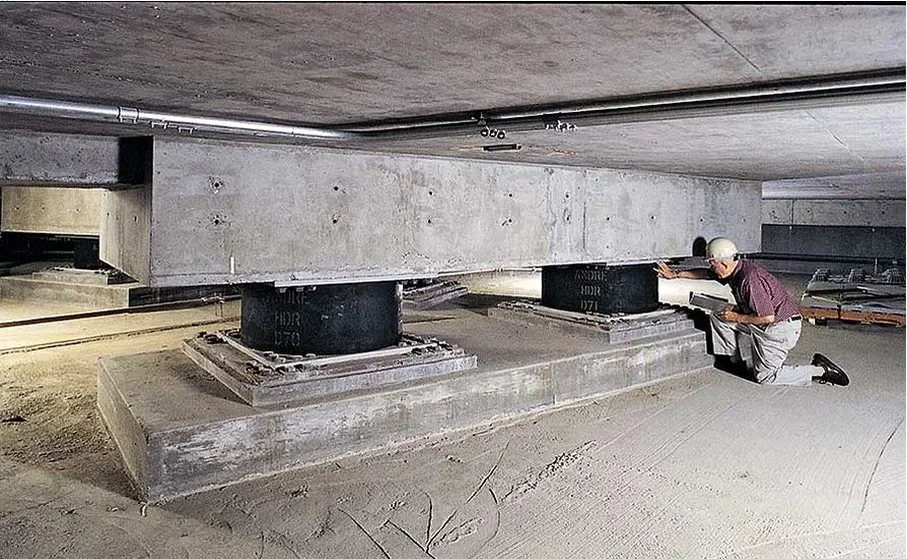
San Bernardino sits barely 3 miles from the San Jacinto fault and less than 15 from the southern San Andreas—two of the most active crustal breaks in California. The USGS gives the metro area a 95 percent probability of a M6.7 or larger quake within the next 25 years, a number that forces every structural decision onto a higher tier of rigor. When peak ground accelerations can top 0.8g on a stiff site, conventional fixed-base design pushes lateral-force-resisting systems to their limit. Base isolation seismic design changes that equation: instead of bracing against the energy, we insert horizontally flexible bearings at the foundation interface so the superstructure sees a fraction of the spectral demand. For hospitals, data centers, and emergency-response hubs that must stay online after a major event, the approach is no longer exotic—it is the rational baseline. Our San Bernardino office combines geotechnical characterization with nonlinear time-history analysis to size lead-rubber and triple-friction-pendulum isolators that keep interstory drift below 0.5 percent under the MCEₓ event. Before the isolation system is locked in, we often run a shear-wave velocity profile with MASW to refine the site class from the default D to a measured C, which can shrink bearing displacement by 15 to 20 percent.
A base isolation system that cuts spectral acceleration by 60 percent can be the difference between an operational facility and a condemned structure after the San Jacinto fault ruptures.
How we work
The 2022 California Building Code—which adopts ASCE 7-22 Chapter 17 by reference—requires every base isolation design to demonstrate stable hysteretic behavior through three full cycles of the maximum considered earthquake displacement. In San Bernardino that displacement routinely lands between 20 and 30 inches on Site Class D profiles, so the isolator test protocol must cover a velocity range from 0.5 to 40 inches per second without force degradation. We model each bearing in ETABS or SAP2000 with coupled bilinear plasticity links that capture the post-elastic stiffness ratio, yield force, and the lead-core heating effect during long-duration pulses. A key San Bernardino nuance is the basin-edge effect: deep sediments in the Santa Ana trough trap long-period energy that can push an isolation period of 3.5 seconds into resonance if the moat clearance is undersized. Our default moat dimension is 1.2 times the 84th-percentile displacement plus 12 inches for torsion, verified with a set of 11 spectrum-matched ground motions scaled to the site-specific uniform hazard spectrum. The isolator upper surface is detailed with a reinforced transfer diaphragm, and all utility crossings—chilled water, medical gas, medium-voltage feeders—get stainless-steel braided loops rated for the full displacement envelope. We also specify laminated neoprene pads at vertical plumbing drops to decouple the superstructure from rigid soil connections.
Site-specific factors
The dry, compacted alluvium that underlies much of San Bernardino can look deceptively competent during a standard boring campaign, but it sits atop a deep sedimentary basin that amplifies long-period motion in the 1-to-3-second band. A fixed-base steel moment frame tuned to 1.5 seconds can therefore see resonant amplification right where the isolation system is supposed to filter energy. The bigger risk, however, is the near-field pulse: a M7 rupture on the northern San Jacinto segment could deliver a fling-step displacement of 4 to 6 feet at the fault trace, with velocity pulses exceeding 60 in/s. Isolators designed only for the uniform-hazard spectrum, without a pulse-specific check, may bottom out against the moat wall. We run separate near-source suites—typically seven records with forward-directivity signatures—to confirm that bearing displacement stays within 85 percent of moat clearance. Another silent threat is long-term creep in the elastomeric layers. San Bernardino summer temperatures above 105°F accelerate oxidation in low-durometer compounds, so we specify shear modulus stability verified through 3,000-hour oven aging per ISO 22762-3 before accepting any bearing lot.
Questions and answers
What base isolation bearing types are permitted under ASCE 7 for San Bernardino projects?
ASCE 7-22 §17.2 recognizes elastomeric bearings (lead-rubber, high-damping rubber) and sliding bearings (flat and curved surface friction pendulum). In San Bernardino, lead-rubber bearings are common for buildings up to 12 stories because they carry out self-centering and rate-independent damping. Triple-friction pendulum isolators are preferred for taller or irregular structures where large displacement capacity and adaptive stiffness under different hazard levels matter. Both types must pass prototype tests covering the full range of thermal and scragging effects.
How much does a base isolation seismic design package cost for a mid-rise building in San Bernardino?
For a typical 4-to-8-story essential facility in San Bernardino, the complete engineering package—site-specific ground motion development, nonlinear modeling, bearing specification, and peer review coordination—ranges from US$4,060 to US$8,680, depending on the number of ground motion suites and the complexity of the superstructure framing.
Does the San Bernardino basin effect really change the isolation design parameters?
Yes, measurably. Deep sediments in the Santa Ana River trough amplify spectral ordinates at periods between 1 and 3 seconds, which is precisely the isolation range. If you ignore basin amplification, the computed bearing displacement can be 10 to 18 percent lower than what a site-specific basin model predicts. We incorporate SCEC community velocity models to correct the uniform hazard spectrum before scaling ground motions.
What moat clearance is typically required for an isolated building near the San Jacinto fault?
For a Site Class D profile within 5 km of the San Jacinto fault, we typically specify a moat gap of 28 to 34 inches for a 4-story steel braced frame—this accounts for the 84th-percentile MCEₓ displacement plus torsion and an allowance for the near-fault velocity pulse. The clearance is verified with seven forward-directivity records scaled to the risk-targeted MCE.
Can an existing building in San Bernardino be retrofitted with base isolation?
It is feasible but demanding. The existing column bases must be severed and a new transfer diaphragm constructed below the ground floor, often requiring temporary jacking of the entire superstructure. We have applied this technique to unreinforced masonry and non-ductile concrete buildings in the Inland Empire, and the key engineering challenge is maintaining vertical load path continuity during the cutting sequence while keeping the building operational above.