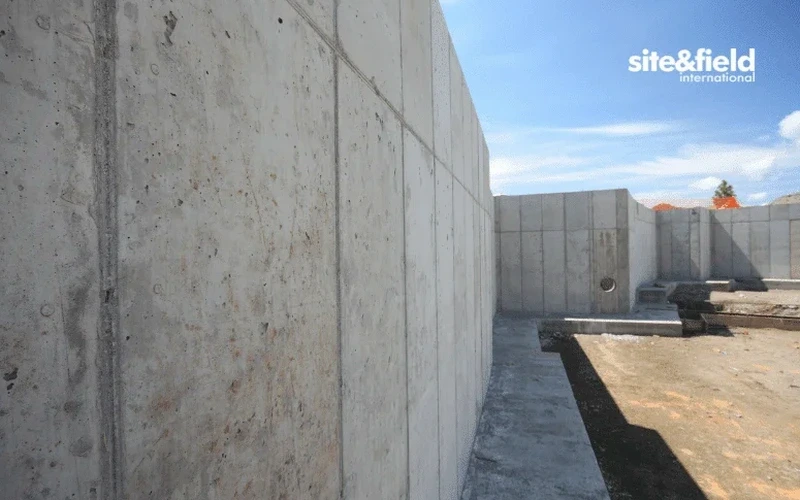
San Bernardino sits at roughly 1,050 feet above sea level, right where the urban grid meets the steep slopes of the San Bernardino Mountains. Every year, our lab sees retaining wall design projects that underestimate what those foothill soils can do when they get wet. We're not just talking about a simple gravity wall here. The alluvial fan deposits and weathered granite that dominate the area create lateral earth pressures that shift dramatically between dry summer months and the winter rainy season. Our team runs the full program: subsurface exploration with SPT drilling to nail down the stratigraphy, followed by direct shear testing on undisturbed samples to get friction angles we can actually rely on. When a property drops six feet across a backyard, a generic design won’t cut it—you need local data and a team that understands how the San Andreas and San Jacinto fault zones influence every retaining structure in the valley.
In San Bernardino, the difference between a wall that lasts and one that leans is usually drainage—and we design for the worst ten-year storm event.
Site-specific factors
San Bernardino’s expansion boom in the 1950s and 60s pushed residential development onto hillsides with steep natural gradients, often with minimal grading oversight by today’s standards. We’ve seen old stone walls on properties near Perris Hill that were built without any engineering, now leaning into neighboring lots. The risk is compounded by the city’s location in a high-seismicity corridor. During a major event on the San Jacinto fault, a poorly designed retaining wall can expertise inertial forces that double the lateral earth pressure, leading to a sudden collapse. Expansive soils add another layer of complexity. When the clay fraction in the retained soil exceeds 15 percent, seasonal wetting and drying can exert swell pressures that crack a cantilever wall’s stem over just a few years. A retaining wall design without a site-specific geotechnical investigation is gambling with long-term stability. Our lab provides the shear strength parameters and swell test data that structural engineers need to detail reinforcement correctly and specify control joints that actually work.
Questions and answers
How much does retaining wall design cost for a San Bernardino residential project?
For a typical residential retaining wall design in San Bernardino, including geotechnical investigation, laboratory testing, and engineer-stamped calculations, the cost ranges from US$1,120 to US$3,840. The final price depends on wall height, site access, and the number of borings or test pits required to characterize the slope.
What type of retaining wall works best on decomposed granite slopes?
In decomposed granite terrain common around San Bernardino, cantilever reinforced concrete walls and segmental block walls with geogrid reinforcement both perform well, provided the foundation bears on competent material. The key is preventing water from saturating the DG behind the wall, as it loses apparent cohesion rapidly when wet. We typically recommend a cantilever wall with a key if the slope exceeds 2:1.
Do I need a building permit for a retaining wall over 3 feet in San Bernardino?
Yes. The City of San Bernardino generally requires a building permit for any retaining wall over 3 feet in height measured from the bottom of the footing, or for any wall supporting a surcharge like a driveway or structure. Taller walls require structural calculations and a soils report stamped by a California-licensed engineer. We prepare the geotechnical portion of the submittal package per city requirements.