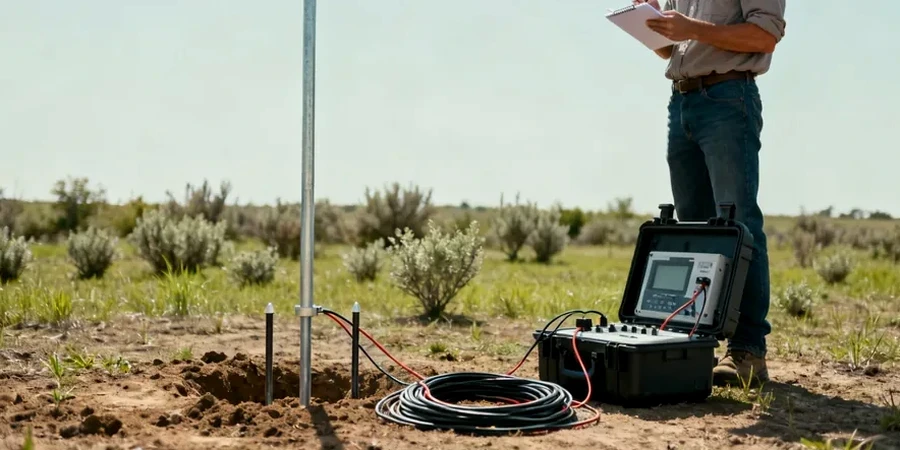
A common mistake in San Bernardino is assuming uniform soil beneath a site based on a single surface observation. Alluvial fans spreading from the San Bernardino Mountains bury buried channels and perched groundwater pockets that only a vertical resistivity sounding can map. When a contractor hits unexpected saturated silt at 12 feet, the project schedule collapses. Our lab runs VES surveys under ASTM D6431, using Schlumberger arrays with AB/2 spacing up to 200 meters. The resulting 1D resistivity models give engineers a clear depth-to-bedrock profile and water table estimate before any backhoe enters the parcel. For sites near the San Jacinto Fault zone, combining resistivity with a seismic refraction profile cross-validates the depth to competent bearing strata and reduces drilling unknowns.
Depth-to-bedrock uncertainty drives 40% of change orders in San Bernardino foothill projects—a VES survey eliminates that guesswork before excavation starts.
How we work
At 1,049 feet elevation, San Bernardino sits on a complex basin fill where coarse gravel lenses alternate with fine lacustrine clay deposited by Pleistocene Lake Manix outflows. These contrasts produce resistivity values ranging from under 10 ohm-m in saline clay to over 500 ohm-m in dry cobble layers. We acquire data with a 4-electrode Wenner or Schlumberger spread, injecting controlled DC current and measuring potential difference at each AB/2 increment. Interpretation follows the Zohdy inverse method, iterating layer resistivities until the synthetic curve matches field data to within 3% RMS error. Our processing chain includes despiking, smoothing, and topographic correction when slope exceeds 5 percent—a frequent condition on hillside lots north of Route 210. The output is a calibrated layer model: thickness and true resistivity per geoelectric unit.
Site-specific factors
San Bernardino's climate swings from 16 inches of winter rainfall on the valley floor to zero precipitation in summer, creating seasonal groundwater fluctuations that wreak havoc on resistivity interpretation if surveys are run at the wrong time. Dry surface sand in August can act as an insulating cap, forcing current to flow deep and mask shallow conductive layers. Conversely, heavy rain in February saturates the vadose zone and collapses resistivity contrasts, making clay lenses indistinguishable from wet silt. We schedule VES acquisition in late spring or early fall when moisture conditions are representative of the annual mean. For sites within the Santa Ana River floodplain, we run the sounding at two seasonal extremes and compare the profiles to bracket the range of apparent resistivity variation a foundation will actually expertise.
Questions and answers
How deep can a VES survey see in San Bernardino alluvial soils?
Investigation depth depends on the maximum current electrode spacing AB/2. With our 200-meter AB/2 limit, the effective depth of penetration reaches roughly 60 to 100 meters in the San Bernardino basin fill, assuming average resistivities between 20 and 200 ohm-m. Deeper targets require a longer cable spread or transition to time-domain IP methods.
What is the cost of a VES survey for a single-family lot?
For a standard residential parcel with one VES sounding to 100 m AB/2, the cost ranges from US$670 to US$900. This includes field acquisition, data processing with inversion, a written report, and a depth cross-section. Sites with steep terrain or access constraints may require additional labor hours.
Can VES distinguish between dry gravel and cemented hardpan?
Both materials can exhibit high resistivity—over 300 ohm-m—making them difficult to separate by resistivity alone. When this ambiguity matters for excavation planning, we recommend pairing the VES with a seismic refraction line. The hardpan will show a P-wave velocity above 1,200 m/s, while dry gravel typically stays under 900 m/s.
How long does a VES survey take on site?
A single Schlumberger sounding with AB/2 to 200 meters requires approximately 90 to 120 minutes of field time, including electrode layout, contact resistance checks, and data acquisition at 20 to 25 spacing increments. A four-point grid across a half-acre site is typically completed in one working day.
Is a VES survey affected by buried utilities?
Yes. Buried metallic pipes, conduits, and reinforced concrete can distort the current field and produce anomalous apparent resistivity readings. We require a utility clearance and mark-out before the survey. During interpretation, we flag any electrode spreads that cross known utility corridors and note the potential interference in the report.