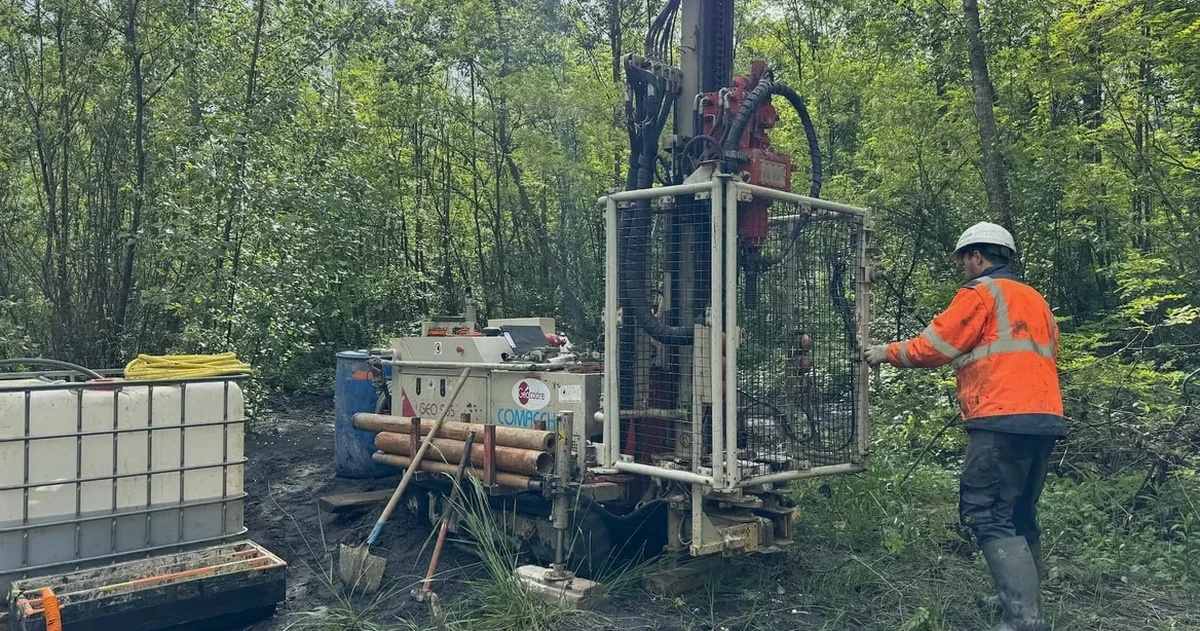
A warehouse expansion near the 215 freeway started showing differential settlement within the first two months of operation. When we took Shelby tube samples at 15 and 30 feet, the upper layer was compacted fill over a lens of saturated sandy silt that had never been properly characterized. That project, like many across San Bernardino, needed more than a basic report. A soil mechanics study in San Bernardino has to account for the basin's layered alluvium, the proximity to the San Jacinto fault, and the water table fluctuations that shift after every heavy rain season. Our laboratory runs each sample through the full program: classification per ASTM D2487, direct shear on undisturbed specimens, and consolidation tests that reveal exactly how much settlement to expect under the proposed slab loads. Before breaking ground on the north side of the city, the team combined the triaxial data with a liquefaction screening because Caltrans and city reviewers now require it for any structure over two stories in Seismic Design Category D.
A soil mechanics study in San Bernardino is not complete without direct shear on the basin fill silts: the cohesion intercept can drop 40% when the sample saturates.
How we work
San Bernardino's building stock tells the story of rapid postwar expansion: neighborhoods laid out in the 1950s on ground that was never instrumented, light-frame construction on spread footings sized by rule of thumb rather than bearing capacity calculations. Today, when an owner wants to add a second story or a developer proposes a four-over-one podium on E Street, the city requires a soil mechanics study that conforms to the current California Building Code. That means we are pulling disturbed and undisturbed samples across the site, running Atterberg limits to establish plasticity index, and correlating SPT N-values with undrained shear strength for cohesive layers. The Atterberg limits data often reveal expansive clay seams in the northern foothills that would heave a lightly loaded slab within two wet-dry cycles. Our lab processes each sample within 24 hours of extraction so moisture content and soil structure are preserved, and the final report includes both the lab curves and the field logs organized by boring number and depth interval.
Site-specific factors
The triaxial cell in our San Bernardino lab runs three specimens per depth interval: one at in-situ confining pressure, one at 1.5x, and one at 2x. That triangle of Mohr circles is what separates a foundation that settles half an inch from one that tilts. When a contractor calls us about a site on West Baseline Road where the bore log shows alternating sand and clay lenses, we pull the Shelby tubes from storage and run consolidated-undrained tests with pore pressure measurement because the drained and undrained behaviors diverge sharply in that stratigraphy. If the CU test shows a friction angle below 30 degrees and the project has a basement level, we flag it immediately: the excavation support system needs a deep excavation monitoring plan with inclinometers and settlement points, and the shoring designer must have the true Su profile, not an empirical correlation from blow counts alone.
Questions and answers
How long does a soil mechanics study take from drilling to final report in San Bernardino?
For a typical commercial lot with three to five borings, we complete the field work in one day and the laboratory phase in seven to ten working days. The final report, which integrates the field logs, lab data, and geotechnical recommendations, is usually delivered within three weeks. Complex projects with consolidation testing or triaxial suites may add five to seven days.
What is the cost range for a soil mechanics study on a single-family residential lot in San Bernardino?
Based on recent projects in the San Bernardino area, a soil mechanics study for a standard residential parcel runs between US$3,130 and US$5,640. The final figure depends on the number of borings, the depth to competent bearing strata, and the specific lab tests required by the structural engineer.
Does the city of San Bernardino require a soil mechanics study for a retaining wall under four feet?
The reference range for this service in San Bernardino is US$3.130 - US$5.640. The final price depends on the project scope and volume.
Can you test for expansive soils in San Bernardino?
Yes. We run Atterberg limits and percent passing the No. 200 sieve on every sample from the upper 10 feet. If the plasticity index exceeds 15 and the fines content is above 50%, we perform a swell-consolidation test in the oedometer to measure the percent swell under a 1 psi surcharge. This data is critical for slab-on-grade design in the northern neighborhoods where clay seams are common.
What makes the alluvial soils in the San Bernardino basin different from coastal plain deposits?
The basin fill here is coarser and more angular because the source material comes from the San Bernardino Mountains and is deposited by high-energy streams. That means the friction angles are often higher than typical coastal silts, but the lenses are highly discontinuous. A soil mechanics study in San Bernardino must sample at close vertical intervals to catch the interbedded clay layers that control stability and drainage.