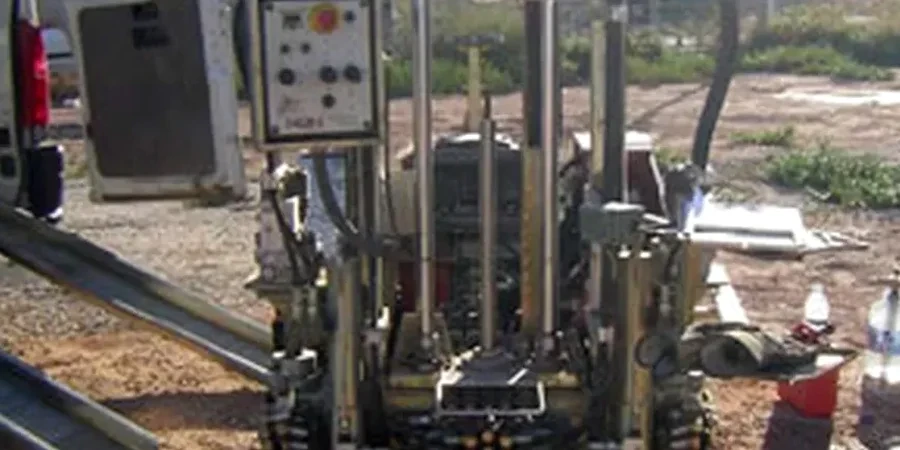
One of the costliest mistakes we see in the Inland Empire is a geotechnical report based solely on SPT blow counts that misses a thin, unstable silt layer at depth. In the alluvial fan deposits spreading south from the San Bernardino Mountains, these interbedded lenses are common and can cause differential settlement that standard drilling simply won't flag. Our CPT testing in San Bernardino eliminates that blind spot. By advancing a calibrated cone at a constant 2 cm/sec, we capture continuous tip resistance, sleeve friction, and pore pressure data — three parameters that together paint a far sharper picture than a split spoon sample grabbed every five feet. For engineers working on the former Norton Air Force Base redevelopment parcels or the logistics hubs near San Bernardino International Airport, this level of stratigraphic resolution becomes the difference between a foundation that performs and one that needs a costly retrofit. We run our sismic CPT correlations directly from the raw cone data, giving you a site-specific liquefaction assessment without waiting for lab cyclic triaxial results.
Continuous CPT data catches the soft seams and transition zones that SPT sampling intervals routinely skip — and in San Bernardino's layered alluvium, that's where the settlement risk hides.
Site-specific factors
Comparing two sites within San Bernardino city limits illustrates why assuming uniform soil conditions is dangerous. A commercial warehouse pad near Baseline Street sits on relatively clean, granular alluvium from the Cajon Wash; CPT tip resistances there often exceed 150 tsf below 15 feet, and pore pressure dissipation is nearly instantaneous. Five miles south, close to the Santa Ana River channel, the same cone push encounters normally consolidated silty clays with corrected tip resistances below 10 tsf to depths of 40 feet — and pore pressure dissipation can take over an hour per station. A geotechnical consultant who treats both sites with the same bearing capacity assumption will get one right and the other wrong. For foundation design in San Bernardino's variable basin fill, cone penetration test results carry out stratigraphic resolution fine enough to separate competent bearing strata from compressible layers, letting the structural engineer place footings or pile tips where the numbers actually support the design load, not where the boring log guessed the good ground started.
Questions and answers
How much does CPT testing cost in San Bernardino?
For San Bernardino projects, budget between US$150 and US$260 per sounding meter, depending on whether you need basic mechanical cone data or full piezocone with pore pressure dissipation testing. A typical single-story commercial building investigation with three 50-foot pushes would fall in the mid-range. Mobilization within the I-215/I-10 corridor is straightforward; remote foothill sites east of the 330 may add a modest travel surcharge. We can carry out a fixed-price proposal once we have a site address and the approximate number of soundings required.
Do you need a drill rig for CPT, or is it self-contained?
Our CPT rig is a self-contained 20-ton truck with hydraulic push cylinders and an integrated data acquisition system. No drilling fluid, no cuttings, no hollow-stem augers. We set up on pavement, compacted fill, or graded pad with minimal disturbance — the anchor system uses helical earth screws that leave small-diameter holes we patch after the push. For sites with a thick crust or cobbles above 5 feet, we can pre-drill through obstructions and then continue the cone push from the bottom of the pre-drilled hole.
How does the City of San Bernardino review CPT data for building permit submittals?
The City accepts CPT results as part of the geotechnical investigation package under IBC Section 1803, provided the report is stamped by a California-licensed geotechnical engineer. Our deliverables include the raw cone data files, a soil behavior type log per Robertson (1990), corrected tip resistance and friction ratio plots, and interpreted geotechnical parameters. The plan check engineer will typically cross-reference CPT-derived shear wave velocities against the IBC site class table — which is why we include Vs data (either measured directly via seismic cone or correlated from qc) in every report destined for a permit submittal.
Can CPT replace standard SPT borings entirely for my San Bernardino project?
It depends on the project scope and the site geology. On clean alluvial sands and silts — common across much of the San Bernardino valley floor — a CPT-only program can fully characterize the subsurface for shallow foundation design and liquefaction screening. If your site is in the older cemented terrace deposits near the foothills, where refusal may occur above 30 feet, or if you need undisturbed samples for laboratory strength testing, we typically recommend a hybrid program that combines several CPT soundings with one or two mud-rotary borings for sampling and rock coring. We'll advise on the right mix during the proposal phase.